How does independent site Shopify make products easier to be selected by AI shopping assistants?
It dismantles the logic of products entering AI shopping recommendations, from parameter structure, scene description, evaluation evidence to compliance boundaries, and provides practical methods to improve products selected by AI and avoid common pitfalls such as false propaganda and keyword stuffing.

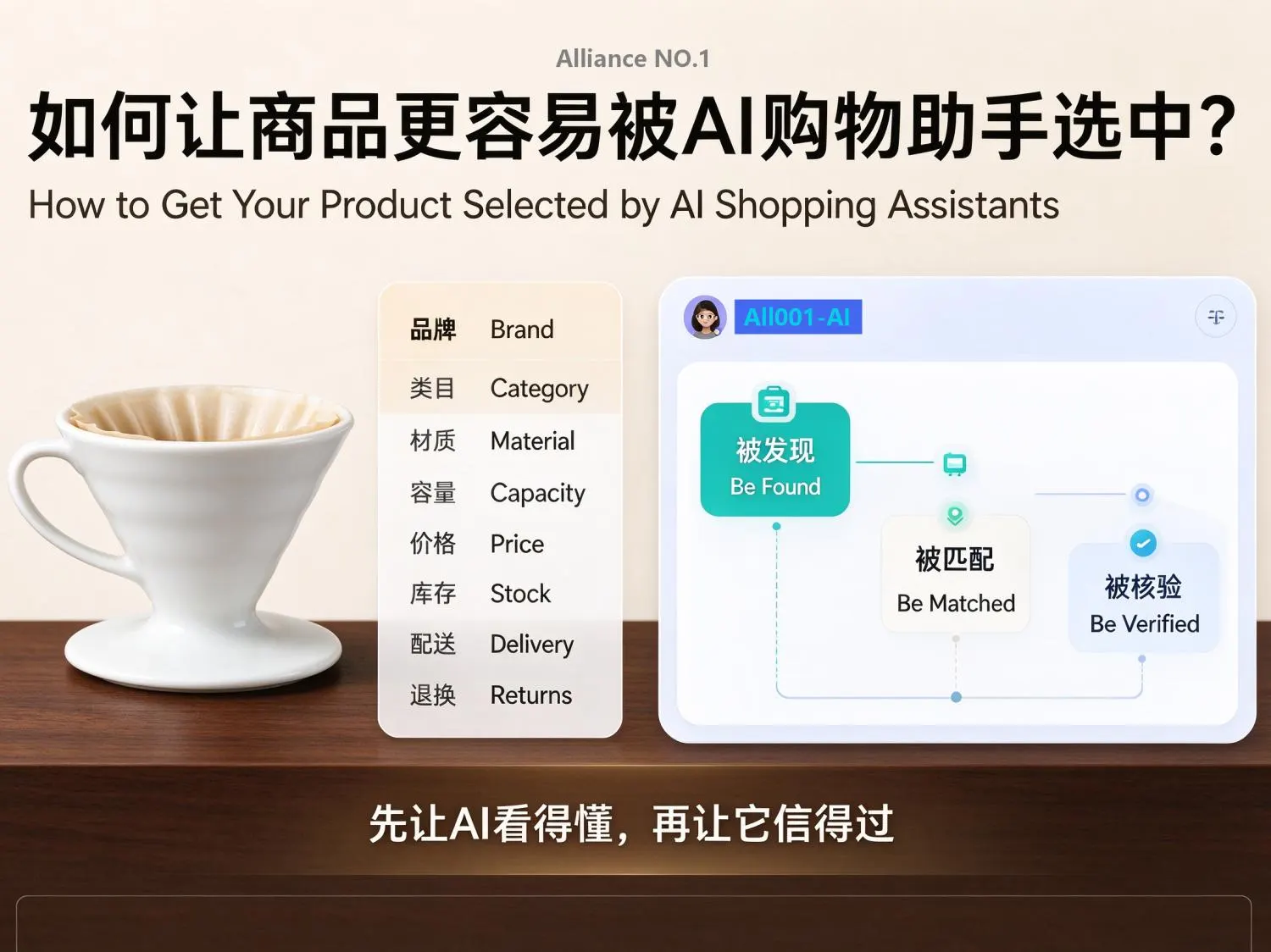
🔥How to make products easier to be selected by AI shopping assistant?
🔥Let’s break the misunderstanding first: Most sellers will fill the title with more than 20 words such as "coffee filter cup, hand brewing, ceramics, gifts, boutiques", etc., and then repeat "best" several times. But the AI shopping assistant is not a keyword counter: the titles are too complicated, making it difficult to determine what the product is, who it is suitable for, and whether it meets the budget.
🤖The real selected link is: first discovered, then matched, and finally verified. The product page cannot be found, the price and inventory do not match, and the return and exchange rules are unclear. Even if the material parameters are correct, you may be out of the game. Let’s use a real product to connect the entire link. 💡
🎯Case study: Hario V60 02 ceramic hand filter cup
☕Case setting: The independent website uses Shopify, the product is Hario V60 02 white ceramic filter cup, the store walkthrough price is $24, and there are 42 pieces in stock; the specifications are entered as ceramic material, about 300g, up to 500mL, suitable for 1 to 4 cups. The current packaging and instructions must still be reviewed before going online. 🎯
🧱Step one: Establish a "fact ledger", don't let AI guess
📝Create fields in Google Sheets: SKU, brand, category, material, size, weight, capacity, adaptation scenarios, packaging list, cleaning method, price, inventory, delivery time, return policy, source link, verification date. Fill in the facts first, then write the copy. 🔍
🔎The packaging list, size and weight are subject to the instructions and physical measurements; do not fill in guess values for GTIN. The unverified "dishwasher safe", "food grade certification" and "professional grade" are directly marked as pending confirmation. Product descriptions can only quote the content in the ledger, which is the first gate to prevent false advertising. ✅
🛠️Step 2: Convert parameters into product pages that can be parsed by machines
🛒Enter the Shopify backend Products → Hario V60 02 → Variants, set price $24, inventory 42, weight 0.30kg and unique SKU; the title is written as "Hario V60 02 Ceramic Pour-Over Dripper, White, 1–4 Cups, 500 mL", without adding synonyms. 📦
✍️The text is arranged according to "Who it is suitable for → What to solve → Verified parameters → What is in the package → What is not suitable → Delivery and return". When using Products → Add product → Generate with AI, only allow it to rewrite verified facts and do not add selling points on your own. 🔍
🎯Step 3: Supplement scene description and evaluation evidence
🗣️The scene should be specific: "Suitable for 1 to 4 cups of daily hand brewing", "Brewing by one person in the office", "Giving to those who have just started hand brewing", and make it clear that "filter paper needs to be purchased separately". Don’t include unrelated uses such as office, camping, barista, etc. just to cover the search terms. 🎯
⭐Evaluation evidence can be collected with the free tier of Judge.me: only mark real buyers and ask whether the capacity is sufficient, whether the size is easy to store, whether there are missing parts, and whether the packaging is damaged. You can be rewarded for filling in the questionnaire, but cannot be rewarded for positive comments; only when the original text is displayed, AI will have the opportunity to quote it. 💬
🔌Step 4: Access product feed and structured data
📡Install Shopify's Google sales channel, the path is Apps → Google sales channel → Connect account → Google Merchant Center. Go to Products → Feeds → Shopify Feed → Diagnostics in Merchant Center to handle price, image, inventory and category errors one by one. 🔍
🧩 Check whether JSON-LD such as Product, Offer, availability, etc. are complete in Online Store → Themes → Customize → Edit code; do not add it repeatedly if there is already output. Use Google Rich Results Test and Schema.org Validator to check to ensure that the page, feed, and the three backend prices and SKUs are completely consistent. ✅
🎨Step 5: Vision is not decoration, but evidence
🎨The color scheme uses warm white #F7F2E9, dark brown text #3A2A20, and turquoise accent color #147D77; only dark text is placed on the light background. Use Inter for English and Noto Sans SC for Chinese; the title is 36px, the text is 20px, and the description is 14px. The mobile title is reduced to 30px. 👀
🖼️Use 1200px canvas, 12 column grid, 64px margins and 24px spacing. Create 6 1600×1600 pictures: white background of the actual product, size diagram, 500mL capacity indication, brewing steps, package contents/not included, and cleaning reminder. Real shots come from self-photographed or brand-licensed materials; scene images are found from Pexels, and templates are obtained from Canva or Figma. 📸
⚡When making batch drawings, press Ctrl+Alt+K to create a component in Figma, or use ⌘+⌥+K for macOS; press Ctrl+D to copy and name it "HV02-WHT_01_HERO_v1". AI can assist in typesetting, but the shape, lettering and size of the filter cup must be the original image, and the generated model cannot be used to redraw the product. 🔧
📊Step 6: Use the fixed question bank to verify whether you are really selected
🧪 Prepare 20 English questions about budget and purpose, such as "under $30, white, ceramic, 1–4 cups". It is fixed to run ChatGPT Shopping, Google AI Mode, and Perplexity twice each. A total of 120 checks are performed every week. At the same time, the region, whether it appears, referring URL, sorting position, price, inventory, and error parameters are recorded. 📝
📈Core indicators: Appearance rate = number of occurrences ÷ 120; citation rate = number of product links ÷ number of occurrences; constraint pass rate = number of correct price, capacity, inventory, and returns ÷ number of occurrences. The internal online threshold can be set to an occurrence rate of ≥15%, a citation rate of ≥80%, an error price or inventory of 0; these are acceptance lines, not industry statistics. 🚦
🧮Step 7: How to choose between manual route and AI-assisted route
🧭Route A is suitable for 1 to 5 SKUs or sensitive categories: free Google tools plus 4 hours of labor. The advantage is that it is controllable, but the pitfall is that it is slow and easy to miss fields. Route B is suitable for more than 20 standard SKUs: Join ChatGPT Plus and Canva Pro, and organize the same facts and first draft in 1.5 hours. The pitfall is that the model will "complete" non-existent parameters. 🤖
💵 Calculated based on profit contribution per order: selling price is US$24, deducting goods 11, payment fee 0.996, packaging 2.50, freight subsidy 4.50, return reserve 0.72 and Google attribution fee reserve 0.60, leaving $3.684. Monthly profit = number of orders × 3.684 - tool fee - labor fee; when placing 40 orders, the two routes earn $8.36 and $35.86 respectively. The breakeven orders including labor are approximately 38 orders and 31 orders. 📊
🚨Finally check these 5 rollover points
- 🐟Title word pile: only keep the brand, category, key specifications and applicable capacity, and put synonyms in the main text. ✅
- 💥The page price is inconsistent with the feed price: Preview the product page immediately after changing the price in the background, and check Diagnostics. 🔍
- 🧪Make up reviews or parameters: keep the source link, verification date and real purchase mark, delete it without evidence. 🚫
- 📦Missing delivery, returns and exchanges: Configure delivery and return policies by country in the Merchant Center, and then test in the target region. 🌍
- 🖼️AI picture modified product: The generated picture is only for layout reference, and the product outline, logo, and scale must come from the original picture. 🖌️
💎Conclusion: Let the AI understand it first, then make it trustworthy, and finally give it reasons for recommendations. The deliverables of this case today are not a beautiful copywriting, but a factual ledger, 1 parsable SKU, 6 unified visual diagrams and a 120-cell test log; after passing the four acceptance checks, it will be expanded to other SKUs. 🚀