How to track brand exposure in ChatGPT?
It explains how to systematically monitor the difference between a brand's appearance rate, reference position, and competing products in ChatGPT answers, and provides sampling procedures, applicable scenarios, common misunderstandings, and reusable judgment criteria.
How to track brand exposure in ChatGPT?
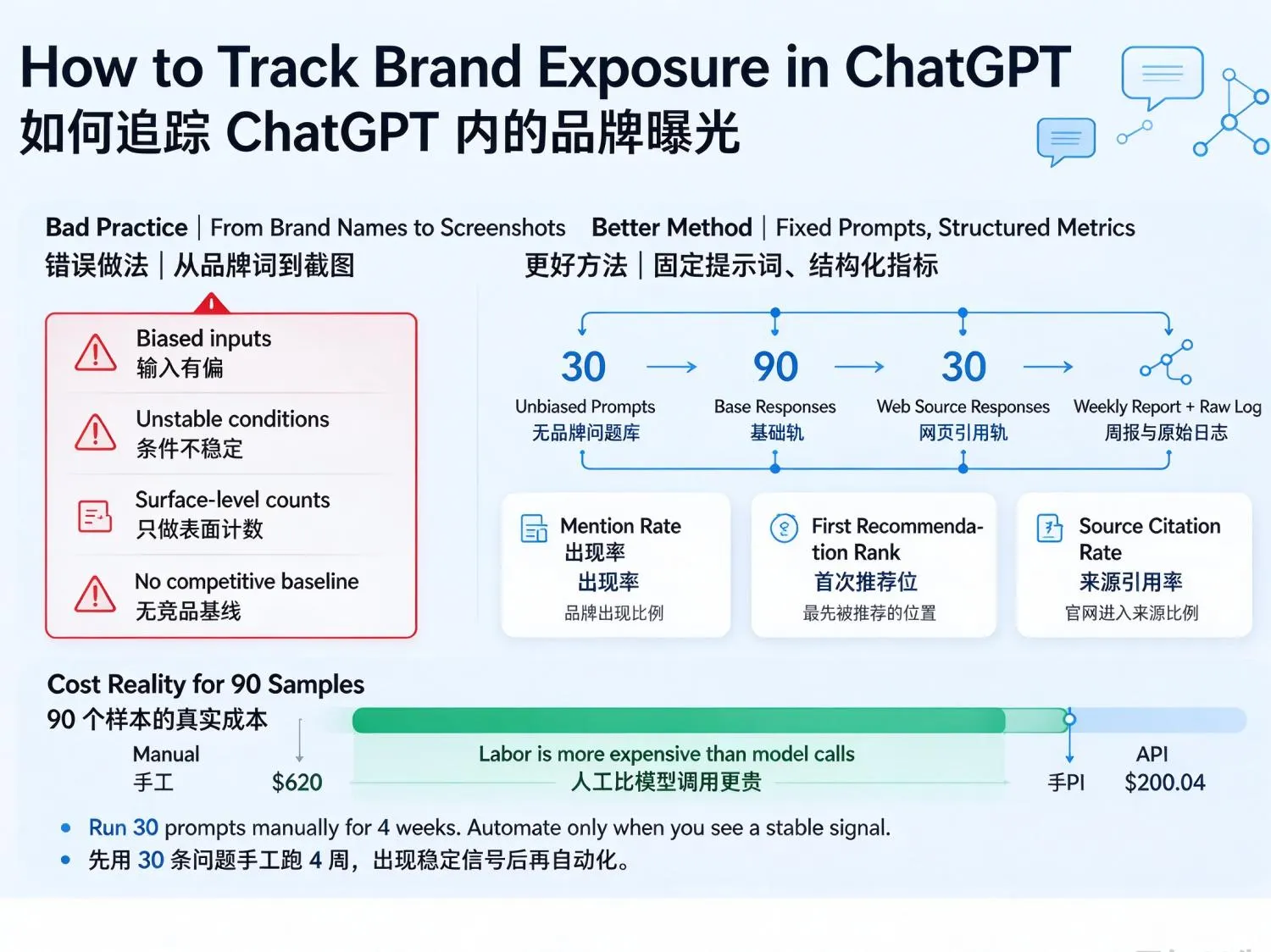
Let’s break the misunderstanding first: Most people only search a few questions with the brand name, then count whether the brand appears in the answers, and take a few screenshots to count as “monitoring”. The problem with this is very specific: the question itself has inserted the brand into the prompt word, and the sample is naturally biased towards the brand; the models, network status and account memory used at different times are inconsistent; the brand is mentioned in passing, which does not mean that it is recommended; ordinary ChatGPT answers have no web page source, but are mistakenly regarded as "quotes". What I got in the end was just a screenshot, with no gap between competing products and no trend.
A truly deliverable solution should output three things every week: Occurrence rate, first recommendation position, and source citation position, and each indicator can be traced back to the original answer.
1. First, focus on a real case
This article runs through cases: monitoring Notion, Asana, Trello, Monday.com, ClickUp, and Confluence in the "Project Management Software" category. The target users are marketing teams, software teams, agencies, remote teams and e-commerce operations teams.
- Basic answer track: 30 questions × each question run independently 3 times = 90 responses, used to count text exposure.
- Webpage citation track: Select 10 questions with the strongest purchase intention from 30 questions, each run 3 times = 30 answers, used to count whether the official website enters the source list.
- Final Delivery: A weekly Google Sheets report, plus a CSV log of original responses.
This article does not make up a "ChatGPT current brand list". The brand performance in the case must come from the logs you actually collected. The numbers in the article are used to illustrate the workload, cost and judgment method.
2. Establish a brand-neutral question bank
1. Generate 30 questions using "5 types of users × 6 question methods"
The five types of users are: 20-person marketing team, 50-person software team, 10-person design studio, remote customer service team, and small e-commerce operations team. 6 types of questions are covered respectively:
- General Category: "What are the project management tools suitable for a 20-person marketing team? Please describe them in the order of recommendations."
- Feature: "Which project management tools support both Gantt charts, automation, and Slack integration?"
- Budget: "What are some cheap project management software for remote teams?"
- Scenario: "What tools should an agency use to manage multiple client projects?"
- Comparison: "Comparison of mainstream project management software based on ease of use, number of templates, and collaboration features."
- Alternatives: "Existing tools are too expensive, what are the alternatives that don't require migrating historical data?"
Each type of user applies the above 6 templates to get P01-P30. In the core question, Do not actively write the name of the brand being monitored, otherwise the brand word prompting effect will be measured. For brand comparison questions, a separate group should be created and "brand demand share" should be reported separately.
CSV retains at least these fields: prompt_id, cluster, segment, prompt, model, run_no, web_mode, status, answer, first_brand, sources, captured_at. In this way, valid answers, repeated answers and failed requests can be distinguished later.
2. Lock collection conditions
Click New chat on the left side of the ChatGPT web version, and then pin the same model through the model drop-down menu above the input box; the basic track is closed Search the web, and the web track opens it. Use a new Temporary Chat for each question to avoid contaminating the next round with content from the previous round.
Go to Settings → Data Controls and if the account offers the Improve the model for everyone option, turn it off. Fixed language, account status, device, and collection time, such as every Tuesday at 10:00 AM. The model name may be adjusted with the version. Do not write "latest version", but write the complete model name displayed on the interface into the log.
In the web track, you also need to click Sources / All sources below the answer to record the source order and domain name. The "appearance in the main text" in the general answer and the "official website cited" in the source list must be counted separately.
3. Batch collection: Choose between ChatGPT manual or API script
Route A: ChatGPT Plus manual collection
Suitable for teams with only dozens of questions per week and no coders. The operation path is New chat → Fixed model → Enter question → Copy answer → Record brand, order and source in Sheets. The advantage is that you can directly see the reference interface; the pitfall is that context is easy to cross, manual copying is time-consuming, and leakage is difficult to find after large-scale.
Route B: OpenAI API batch collection
Suitable for teams that need more than 100 answers per week, fixed parameters and automatic storage. Install the SDK first:
pip install openai
export OPENAI_API_KEY="你的密钥"

import csv, os
from datetime import datetime, timezone
from openai import OpenAI

client = OpenAI(api_key=os.environ["OPENAI_API_KEY"])
brands = {
    "Notion": ["notion", "notion.so"],
    "Asana": ["asana", "asana.com"],
    "Trello": ["trello", "trello.com"],
    "Monday.com": ["monday", "monday.com"],
    "ClickUp": ["clickup", "clickup.com"],
    "Confluence": ["confluence"]
}
prompts = list(csv.DictReader(open("prompts.csv", encoding="utf-8-sig")))

with open("responses.csv", "w", newline="", encoding="utf-8-sig") as rf, \
     open("mentions.csv", "w", newline="", encoding="utf-8-sig") as mf:
    rw, mw = csv.writer(rf), csv.writer(mf)
    rw.writerow(["captured_at","prompt_id","run_no","model","web_mode","status","answer","first_brand"])
    mw.writerow(["captured_at","prompt_id","run_no","brand","position","is_first","in_top3","fit"])
    for p in prompts:
        for run_no in range(1, 4):
            try:
                answer = client.responses.create(
                    model="gpt-4o-mini",
                    input=p["prompt"],
                    temperature=0.2,
                    max_output_tokens=300
                ).output_text
                status = "OK"
            except Exception as exc:
                answer, status = str(exc), "ERROR"
            low = answer.lower()
            hits = []
            for brand, aliases in brands.items():
                positions = [low.find(a) for a in aliases if low.find(a) >= 0]
                if positions:
                    hits.append((min(positions), brand))
            hits.sort()
            top3 = {b for _, b in hits[:3]}
            now = datetime.now(timezone.utc).isoformat()
            rw.writerow([now,p["prompt_id"],run_no,"gpt-4o-mini","OFF",status,answer,hits[0][1] if hits else ""])
            for rank, (_, brand) in enumerate(hits, 1):
                mw.writerow([now,p["prompt_id"],run_no,brand,rank,int(rank == 1),int(brand in top3),""])
temperature=0.2, max_output_tokens=300 and model name must be fixed in the code. Do not completely trust the alias script in the last fit column: for example, an answer that just says "Notion has an AI feature" does not mean that it is recommended as a project management solution and should be manually marked as 0.
4. Calculate the money clearly: the difference between the two routes
Take 90 basic answers as an example. ChatGPT Plus US site price is $20/month; manual copying, checking and organizing are calculated at 8 minutes per item, totaling 12 hours. Labor valuations are flat at $50/hour, so the manual route is 20 + 600 = $620.
API routes assume each input is 350 tokens and the output is 650 tokens. 90 calls total 31,500 input tokens and 58,500 output tokens. To facilitate recalculation, this article uses gpt-4o-mini’s input of $0.15/million tokens and output of $0.60/million tokens as the core price baseline; it must be replaced by the real-time price at platform.openai.com/docs/pricing on the day of official implementation, and taxes and fees will be calculated separately.
The call fee is 31,500÷1,000,000×0.15 + 58,500÷1,000,000×0.60 = $0.0398. Plus 4 hours to build, run, and clean the script, that's $200.04. The difference between the two routes under current assumptions is $419.96. The really expensive thing here is not the model call, but the manual sorting.
The manual route is suitable for first-time verification and checking of the reference interface. The pitfall is the drift of the operation caliber; the API route is suitable for fixed weekly reports. The pitfall is that the web search and citation structure are different from the web version. Therefore, first run 10 questions manually for verification, and then decide whether to automate. Do not set up a complete system on the first day.
5. How to calculate indicators to see the differences between competing products
Import responses.csv and mentions.csv through Google Sheets' File → Import and create an indicator table:
- Occurrence rate: Number of valid responses mentioning the brand ÷ Total number of valid responses.
- First mention rate: The number of times the brand is mentioned first ÷ the total number of valid responses.
- Top three rate: The number of times the brand enters the top three brand positions ÷ the total number of valid answers.
- Average rank: The arithmetic mean of the positions where the brand appears, 1 is the best.
- Official website citation rate: The source list includes the number of search responses to the brand’s official website ÷ the number of valid search responses.
- Recommended adaptation rate: The proportion of brands that not only appear, but actually fit the question scenario.
For example, the occurrence rate formula can be written as =COUNTIF(mentions!D2:D91,A2)/COUNTIF(responses!F2:F91,"OK"); the first mention rate is changed to =COUNTIFS(mentions!D2:D91,A2,mentions!F2:F91,1)/COUNTIF(responses!F2:F91,"OK"). The official website citation rate must use the web page track as the denominator.
The gap between competing products should be expressed in “percentage points”. For example, the log calculates that the first mention rate of Notion is 33.3% and that of Asana is 50%. The difference is 16.7 percentage points, not 33.4%. If the difference exceeds 10 percentage points, drill down to specific problem clusters instead of jumping to conclusions.
Six or five places where cars roll over most often
- Brand in prompt word: Can create false exposure. There are no brand words for the core issues, and a separate group will be created for brand needs.
- Change models or turn on networking midway:The results are not comparable. Check the model, web_mode, account status and collection time fields.
- Failed answers still enter the denominator: Delete records with status other than OK and retain the number of deleted records.
- Equating occurrences with recommendations: Use the fit column to differentiate between "mentions" and "fits for this scenario." All borderline cases of misidentification of aliases should be randomly checked.
- In-text mentions and source citations are mixed: The former belongs to mentions, and the latter belongs to sources; the two sets of denominators cannot be mixed.
7. Reusable Judgment Criteria
The 95% sampling error is about ±10.3 percentage points when the true proportion is about 50% for a 90-item sample. Therefore, a 3-point increase in the occurrence rate in a single week cannot be called a trend. It is recommended to observe 3 consecutive collection windows and compare it with the median of the past 4 weeks.
- Green: The occurrence rate of core problem clusters is ≥40%, and the first mention rate is ≥20%.
- Yellow: Occurrence rate 15%-39%, or first mention rate 5%-19%.
- Red: Occurrence rate <15%, first mention rate <5%, or more than 10 percentage points behind major competitors.
- Citation warning: The citation rate of the official website of Web Track is <10%. Priority is given to checking the crawlability of the official website, third-party evaluation and search result ranking.
This method is suitable for B2B software, AI tools, courses and service brands with clear categories and fixed competing products; it is not suitable for new brands that have just launched and the model has not yet formed a physical recognition, nor is it suitable for broad questions without purchase scenarios such as "the best tool in the world". The latter should be replaced by specific questions with user size, budget, features, and timeframes.